New Japanese Language Requirement for “Engineer / Specialist in Humanities / International Services” Visa (2026 Update)
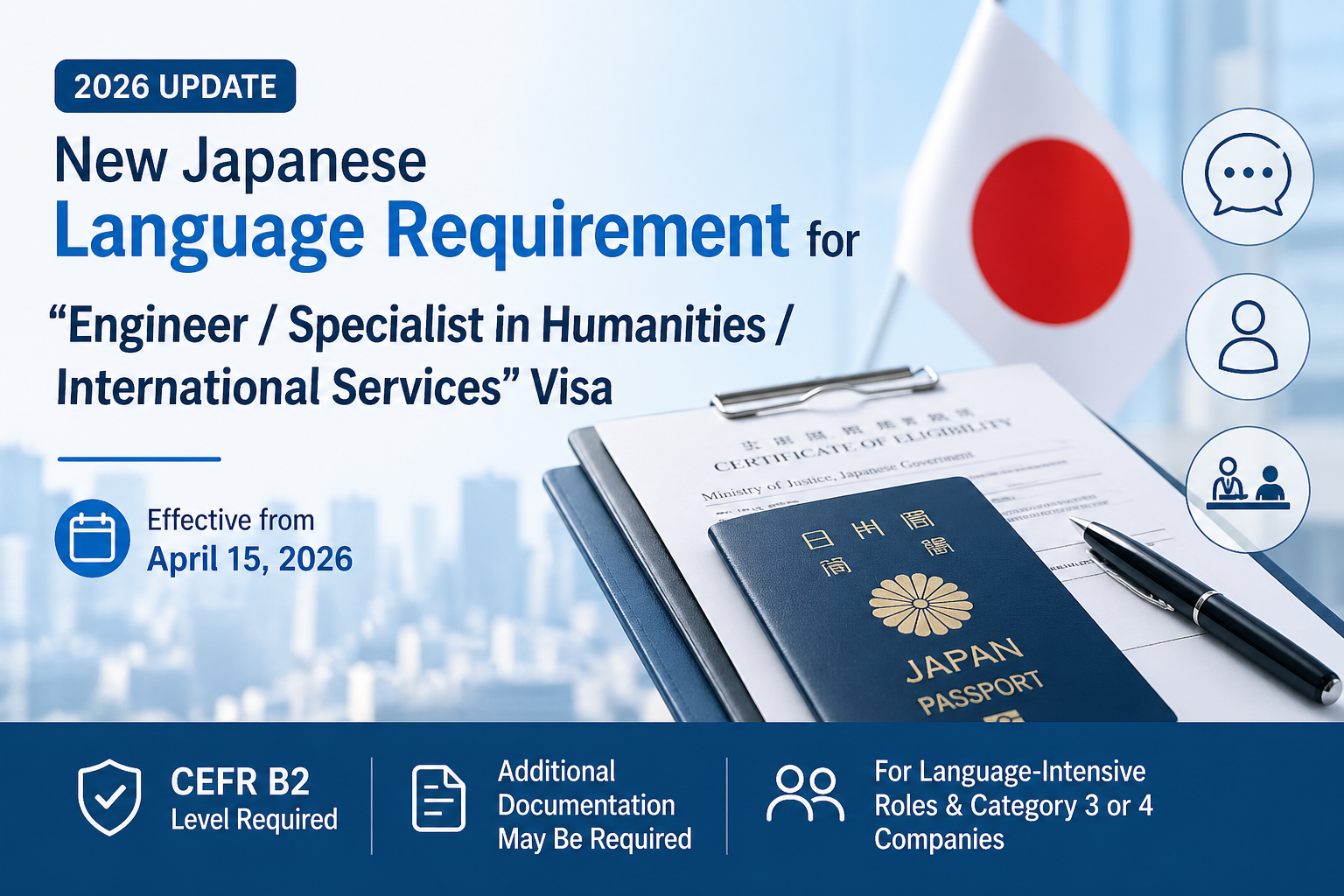
Japan’s immigration policy continues to evolve, and one of the most recent developments is the clarification of Japanese language requirements for applicants under the “Engineer / Specialist in Humanities / International Services” visa (技術・人文知識・国際業務).
In this article, we explain what has changed, who is affected, and how to prepare.
Introduction of Japanese Language Requirement (Effective April 15, 2026)
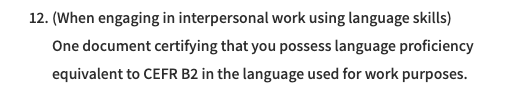
For applications submitted on or after April 15, 2026, additional documentation certifying that you possess language proficiency equivalent to CEFR B2 will be required.
This applies to:
Certificate of Eligibility (COE) applications
Change of Status of Residence applications
For Extension of Period of Stay applications (renewal), the same requirements apply.
However, if the applicant has been continuously engaged in the same type of work as before, submission of these additional documents may not be required.
Please note that the standard required documents—such as the employment contract, company profile, job description, and documents proving the applicant’s educational and professional background—remain unchanged. The above are additional requirements, not replacements.
What is CEFR B2?
CEFR (Common European Framework of Reference for Languages) is an international standard for measuring language ability.
At B2 level, a person can:
Communicate fluently in professional settings
Handle complex conversations and negotiations
Work independently using the language
✔ Accepted Evidence
JLPT N2 or higher
BJT (Business Japanese Test) score of 400 or above
20+ years of residence in Japan
Graduation from a Japanese university or vocational school
Note : For vocational school graduates, additional conditions may apply unless the program is officially recognized by the Ministry of Education.
Who Needs to Submit Proof?
The requirement to submit proof of language ability depends primarily on the nature of the job.
If the position primarily involves language use—such as Japanese communication in customer-facing roles —proof of language ability (e.g., CEFR B2) will be required.
e.g., hotel front desk
If the position does not require Japanese or other language skills as a core part of the job, submission of language proof is generally not required.
Also, company category still plays a role in screening:
Category 3 or 4 companies → More likely to be asked to submit supporting documents at the time of application
Category 1 or 2 companies → Additional documents may still be requested during review, depending on the case
Key Takeaway
This policy change is part of a broader trend in Japanese immigration:
👉 Moving toward “quality-based selection” rather than formal eligibility alone
Language ability is no longer a secondary factor—it is becoming a core requirement, especially for roles involving communication.
How We Can Help
At our office, we regularly assist clients with:
Structuring job descriptions to meet immigration standards
Assessing whether language requirements apply
Preparing supporting documents for visa applications
Advising on risk factors before submission
If you are planning to apply for an “Engineer / Specialist in Humanities / International Services” visa, or if you are an employer hiring foreign staff, early preparation is essential.
Contact Us
If you have questions about your eligibility or application strategy, feel free to contact us for professional support.